
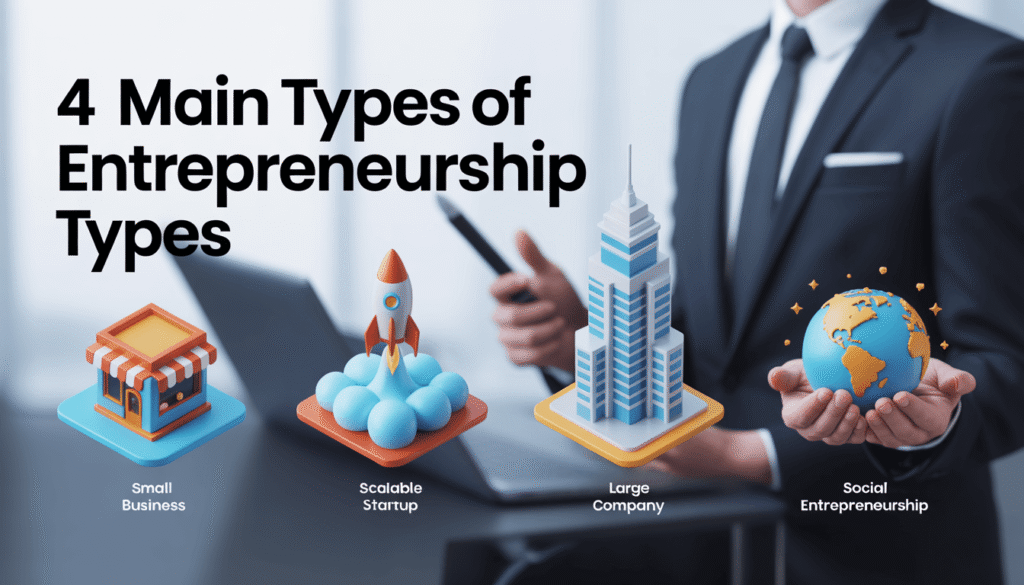

There are 4 main types of Entrepreneurship. Broadly speaking, most businesses can be divided into four categories: Small Business, Scalable Startups, Large Companies, and Social Entrepreneurship. The purpose and style of working for each of these are quite different.
In this article, we’ll explain these four types in simple terms. No complicated terms, just simple examples and clear points so you don’t feel overwhelmed. So, let’s get started!
1. Small Business Entrepreneurship: The Real Hero of the Street
This is the oldest and most common form of entrepreneurship. Its goal isn’t “world domination,” but rather to fulfill a family’s needs and serve the people in its area. You could also call it a “lifestyle business” because it supports the owner’s livelihood.
Simple examples:
- A tea shop or cafe near your home
- A grocery store on a street corner
- A tailor shop that’s been handling people’s clothes for years.
- A local home cleaning or laundry service.
They may never become as big as Google or Amazon, but without them, our daily lives come to a standstill.
Why are they so important?
These businesses are the backbone of our economy. They not only earn money but also provide employment to 2-4 peple in their area. They know their customers by name, which builds trust and they teach the basics of managing money and communicating with customers.
Real Challenges:
Their journey isn’t easy either. They often face these difficulties:
- Often, they have to start a business with their own savings; banks don’t readily grant loans
- When a big mall or supermarket opens, these poor people’s sales are affected
- The owner is the manager and the owner is the worker—this leads to increased fatigue
2. Scalable Startup Entrepreneurship
A scalable startup isn’t a company that just gets by, but one that aims to rocket to the top. These companies start work from day one, determined to reach not just their own city, but the entire world.
Their model is to test a new idea first, and once it takes off, raise funding from investors and scale it rapidly.
Real examples
- Uber and Airbnb: They started from a small city and are now present in every country.
- Ed-Tech Platforms: Like a website that connects teachers with students around the world.
- Health Gadgets: A new watch or device that tracks your health and sells worldwide.
Why are they so special?
They don’t just do business, they change people’s lifestyle. Their biggest weapon is technology. They can reach millions of people overnight and solve big problems (like transportation or education) with a single click.
Challenges in their path
But remember, as glamorous as it sounds, it’s also difficult:
- Selling your idea to everyone and getting funding isn’t easy.
- Finding people who understand your vision and work hard day and night.
- When work progresses too quickly, it becomes difficult to maintain—startups often collapse due to this “over-growth.”
- In the world of technology, a new competitor comes every day, hence it is important to remain alert all the time.
3. Large Company Entrepreneurship
Imagine a very small company that’s been selling the same thing for years. If it doesn’t innovate, people will forget it. Therefore, these companies start a “new business” within themselves. This isn’t a new company, but rather a new color on an old wall or a new branch on an old tree.
Real examples
- Apple or Samsung: They launch not just new phones every year, but also smartwatches and new software services to keep people hooked.
- Car Companies (Toyota/Tesla): When an old petrol car company suddenly starts making Electric Vehicles (EVs).
- Food Brands: Like an old biscuit company suddenly launching a new brand of “Sugar-Free” or “Healthy Snacks.”
Why is this important?
The world is changing very rapidly. If a company, like Nokia or Kodak, persists, it will perish. The purpose of large-scale entrepreneurship is “survival” and moving step by step with the times. This keeps old customers happy and attracts new ones.
Challenges in their path
It’s not easy for small companies to innovate; they face a unique set of challenges:
- Their rules and meetings are so numerous that it can take months to approve a new idea.
- Old departments often block new ideas because they prefer to work in the same old ways.
- Small companies (startups) are very nimble; by the time the big company makes a decision, the startups have already taken the lead.
4. Social Entrepreneurship: A Business Started from the Heart
The purpose of social entrepreneurship isn’t just to make a profit, but to solve a social issue. These people work by combining a business mind and a humanitarian heart. Their mission is to make the world a better place to live, whether it’s eliminating poverty or saving the environment.
Real Examples
- Clean Water Project: A company that creates cheap filters to prevent people from drinking dirty water in the countryside.
- Talented Youth: A charity that teaches poor children coding or a skill so they can stand on their own feet.
- Recycling Business: Making useful things from old waste or plastic to keep the earth clean.
- Akhhuwat or Edhi Foundation (Local Context): They used business models to serve the people.
Why is this important?
Sometimes government or charity grants can’t solve every problem. Social entrepreneurs find new and “sustainable” solutions to these problems. They not only give charity, but also teach people to stand on their own feet.
Difficulties in their path
Even doing good deeds comes with challenges:
- It’s difficult to survive solely on donations, so they have to find a way to bring in some money.
- In business, profit is a good indicator of performance, but measuring social impact is much more difficult.
- The biggest challenge is maintaining a balance between “Mission” (helping people) and “Money” (expenses). Without money, the mission will stall.
Comparing the Four Types
| Type of Entrepreneurship | Main Goal | Growth Speed | Example |
|---|---|---|---|
| Small Business | Stable income, serve local customers | Slow | Local cafe, tailor |
| Scalable Startup | Fast growth, large market | Fast | Tech app, online platform |
| Large Company | Innovation inside a big firm | Medium | New product in established brand |
| Social | Solve social problems | Varies | Clean water solutions |
Why Knowing These Types Helps You
The real benefit of understanding these four types comes when you ask yourself some questions. This isn’t just theory, it’s your “roadmap” that tells you:
- What is your goal? (Money, fame, or fortune?)
- How much risk can you take? (Can you put your entire savings on dawg?)
- What skills do you need? (Management, coding, or just passion?)
- Where will the money come from? (From your own pocket or from a random investor?)
A simple advice: If your heart is in the service of your region and you don’t want to be entangled with random investors, then small business or social entrepreneurship is best for you.
But, if you dream of having your product used worldwide and you want to grow quickly, then take the path of a scalable startup.
Also read:
- What is Digital Entrepreneurship? A Beginner’s Guide to Online Business
- Real-World Examples of Digital Entrepreneurs: Success Stories in the Modern Era
Final Thoughts
Entrepreneurship isn’t a dead-end path—it’s a journey. When you understand these four types, it becomes easier to choose the right path and prepare yourself for the challenges that may arise along the way.
Whether your dream is a small family shop or a startup that can change the world, remember that every path has its own beauty and challenges. No task is too small; it’s your vision and dedication that make it so.
So, choose a path that suits your temperament, keep learning, and don’t be afraid to take the first step. Because every success starts with a small step!
Frequently Asked Questions
Simply put, these four types are: Small Business (local shop), Scalable Startup (fast-growing tech idea), Large Company (new recipe for an old company), and Social Entrepreneurship (work for the welfare of people). Each has a different purpose and path.
Small business is best for most beginners. It’s less risky, you can start with less money, and you can start earning immediately by serving customers in your area.
It’s all about speed and export. A startup wants to be a rocket from the start and take over the world with investor money. Whereas, a small business operates quietly and focuses on its dedicated customers.
Yes, absolutely! That’s called Social Entrepreneurship. In this you also earn profit so that the business can continue running, but your real mission is to solve problems like poverty, dirtiness, or time.
Because if they do not think new, they will become obsolete and die. The world is changing rapidly; if Apple or Samsung stop working on new ideas, then some new startup will leave them behind. Therefore, they are forced to think new to “stay alive”.


Pingback: The Future and Scope of Digital Entrepreneurship in 2026 and Beyond
Pingback: Active vs. Passive Income: Key Differences, Examples, and How to Choose Your Path to Wealth
Pingback: What is Creator Monetization? The Complete Guide to Making Money in 2026