

The best AI tools for small businesses include ChatGPT for content creation, Canva AI for design, QuickBooks with Intuit Assist for accounting, Jasper for marketing copy, and Zapier for workflow automation. These tools help you save time, cut costs, and compete with larger companies without needing technical expertise.
Today running a small business is challenging. You have to be a manager, accountant, and marketing expert all at the same time, which often increases the workload. But in 2026, technology has advanced so much that you no longer need to do all of this alone. Artificial Intelligence (AI) is no longer limited to large companies; it has become a “digital partner” for small business owners, capable of completing hours of work in minutes.
In this complete guide, we’ll talk about the best AI tools specifically designed for small businesses. We’ll see how these tools can save you money and time and help your business grow. So let us understand this world of AI in simple words.
How Can AI Be Used for Small Businesses?
You might think AI is only for big tech companies, but it is actually a game-changer for local shops, freelancers, and small agencies. Here is how it helps:
- Customer Support: You can add a “chatbot” to your website that answers common questions (like “What are your hours?”) even while you’re asleep.
- Creating Content: AI can write your social media captions, blog posts, and emails in a fraction of the time it takes to stare at a blank screen.
- Design and Branding: You can create professional logos, flyers, and videos without needing to hire an expensive designer.
- Organizing Tasks: AI can take notes during your meetings, summarize them, and even put the “to-do” items directly into your calendar.
What Are Some Common AI Types You Should Know?
The word “AI” often conjures up complex coding, but the truth is that today’s tools are quite simple. If you’re running a small business, you don’t need a “tech expert”—just understanding these seven basic types is enough:
- Chatbots: Digital helpers on your website that instantly answer customer questions.
- Writing Assistants: When you’re overwhelmed writing emails or social media posts, these tools make your job easier.
- Image Makers: Design stress is over! With these, you can create professional-looking pictures and ads in seconds.
- Voice Assistants: These aren’t just “Siri”; they can read text for you or act on voice commands.
- Data Helpers: Afraid of numbers? These tools illustrate your sales and trends in simple graphs.
- Scheduling Tools: Eliminate the hassle of setting up meetings. These automatically manage your calendar.
- Customer Support Tools: Speed up issue resolution to keep your customers happy.
The bottom line is that AI isn’t just for tech giants anymore; This is for entrepreneurs like you who want to save their time the smart way.
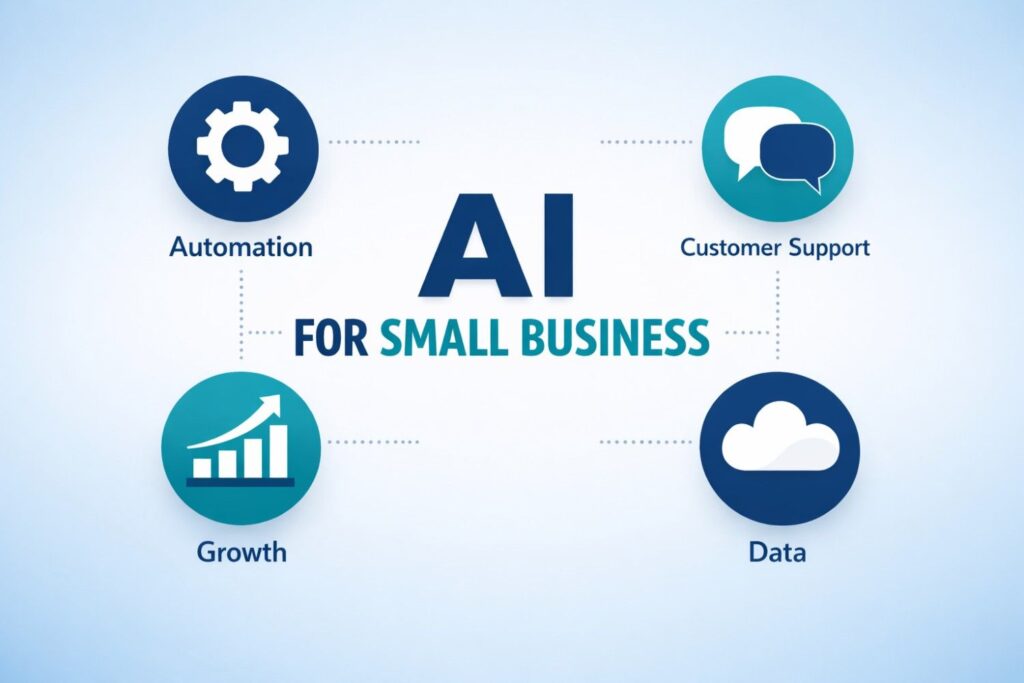
Top 5 AI Tools Every Small Business Should Try
It’s not enough to simply know what AI is; the real success comes when you use the right tools. If you want to make your business “smart,” these five tools can save you a lot of time:
1. ChatGPT (Content and Ideas Expert)
This isn’t just a chatbot, it’s your 24/7 assistant. Whether it’s writing social media posts, responding to long emails, or brainstorming new business ideas—ChatGPT gets the job done in seconds.
- Best for: Content creation and writing.
- Benefit: Your hours of work are done in minutes, and the writing quality is also improved.
2. Canva AI (Graphics Without Design Skills)
You no longer need expensive designers (at least in the beginning!). Canva’s AI features let you create logos, social media posts, and flyers by simply typing text.
- Best of all: For social media graphics and posters.
- Benefit: Simple drag-and-drop, no “designing degree” required.
3. Jasper (Marketing and Sales Player)
If you want your ads and product descriptions to be such that people buy them as soon as they see them, Jasper is the best. It’s specifically designed for writing “marketing copy.”
- Best for: Ads, sales pages, and product descriptions.
- Benefit: It writes things that impress customers.
4. Zapier (Cut of useless tasks)
Many small tasks in business are tedious (like copying data). Zapier integrates your apps (Gmail, Slack, Sheets) together. For example, when a new customer emails you, it will automatically save their name to your list.
- Best for: For putting daily tasks on autopilot.
- Benefit: Eliminates manual work, leaving no room for error.
5. HubSpot AI (Master of Customer Management)
Keeping track of customers and following up is a daunting task. HubSpot’s AI tells you when to contact each customer and how to approach sales.
- Best for: For sales and customer records (CRM).
- Benefit: All your data remains organized and no deal is missed.
Also Read: The Future and Scope of Digital Entrepreneurship in 2026 and Beyond
What Is the 10-20-70 Rule for AI?
Many business owners make the mistake of thinking that simply “buying” an AI tool will solve all their problems. The truth is, AI isn’t some magic trick. To succeed, you need to understand the 10-20-70 rule:
- 10% is the Tool: Only 10% of your success comes from the actual software or algorithm.
- 20% is the Data: You need good information and a clear setup for the tool to work.
- 70% is the People: The biggest part of success is how you and your team change your habits to use the tool every day.
AI is not a magic wand, but a “Power Tool.” And remember, a power tool only pays off when the person using it is skilled!
Why Small Businesses Should Use AI
Ai is not just a tool it can become your business partner that actually helps in:
- Freedom from boring tasks: Avoid wasting time on the same old and tedious tasks; AI will take care of them in seconds.
- Budget savings: Hiring new people for every job is difficult in the beginning. AI takes care of a lot of your manual work, saving you money.
- Increased Online Reach: With AI, you can reach more customers by creating better ads and posts.
- No Room for Error: Humans can make mistakes, but AI manages things with great accuracy.
- Smart Work, Not Hard Work: Achieving more results in less time is the true essence of success.
Remember: You don’t need to become a tech genius. Just pick 1-2 tools that suit your needs and start small. The path will be created!
Tips for Using AI Without Feeling Overwhelmed
New technology always seems a little daunting, but adopting AI isn’t as difficult as it seems. If you’re feeling overwhelmed, try these simple steps:
- Fix one issue first: Don’t blame everything on AI at once. Find just one task that takes up a lot of your time.
- For example: “It takes me hours to write social media posts.” Focus on that for now.
- Start with just one tool: There are thousands of tools in the world, don’t chase them all.
- Pick just one (like ChatGPT or Canva) first and understand it properly.
- Take some time to learn: Free tutorials for every tool are available on YouTube.
- Even 15-20 minutes a day is enough to understand the basics.
- Trial and error: You might not get perfect results the first time.
- If the AI gives the wrong answer, explain it a little or try changing your command (prompt).
Remember: AI is just like a new employee. It takes a little understanding at first, but with time, it becomes your “right hand.”
Also Read: 10 High-Income Digital Marketing Skills to Master in 2026 (Beyond SEO & Social Media)
Final Thoughts
The truth is, AI has opened doors previously only available to small companies. Now you too can provide 24/7 customer service, perform professional marketing, and put boring tasks on autopilot—all without a costly team.
But remember: success isn’t just about buying tools, it’s about setting the right goals and applying the 10-20-70 rule. Focus primarily on inspiring your team and yourself to innovate, not just on accumulating technology.
AI isn’t something magical that will change everything overnight; it simply amplifies your hard work exponentially. It doesn’t replace your strategy or human thinking, but rather gives you time and peace so you can focus on your business’s growth.
Start today: This week, stick to just one tool. Use it for real work. See if it improves. Then, slowly, gradually, move forward. Remember, even small steps are the last step!
Also Read: What is the Scope of Digital Entrepreneurship? Definition, Benefits, and Future Trends
FAQs About AI for Small Business
The real benefits are time and peace. AI takes care of tedious tasks (like writing emails, creating posts, or setting appointments), so you can focus on growing your business.
Absolutely not! Modern AI tools (like ChatGPT or Canva) are as easy as using Facebook or WhatsApp. They come with step-by-step guides to show you the way.
No, AI isn’t a replacement for humans. It’s just a helper that handles the boring work. The “human mind” will always be needed for quality checks, real strategy, and customer engagement.
Not really. Many of the best tools (like ChatGPT and Canva) have free versions that are sufficient for small businesses. Always start with the free ones and upgrade to a paid plan when the business is ready.
Look at your “Pain Points” instead of sifting through them. If content writing is your thing, get a writing tool. If customer handling isn’t your thing, get a chatbot. Only get what you absolutely need.