
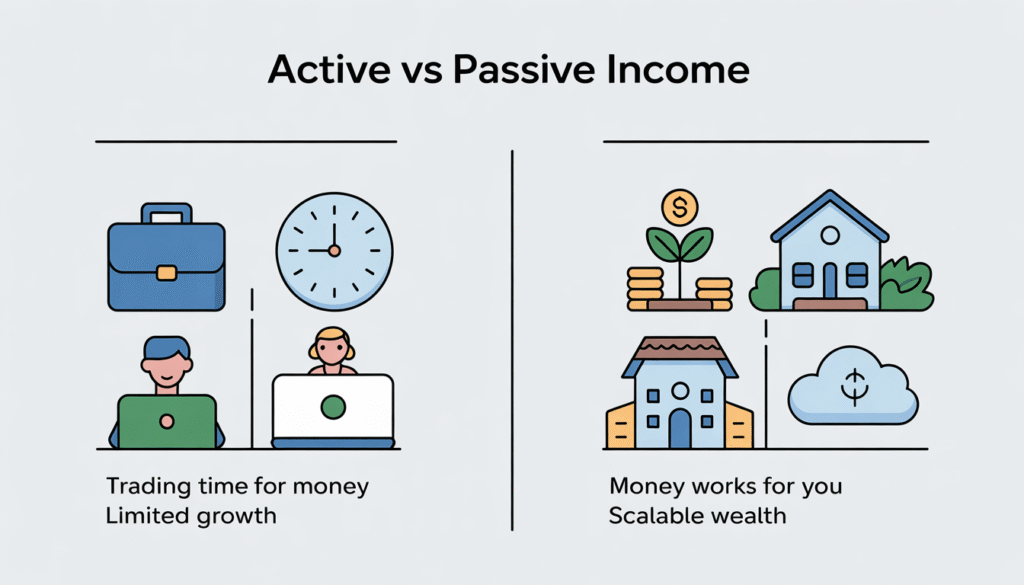

There are two ways to make money: one where you sell your time (Active), and the other where a system you’ve created earns money for you (Passive). Everyone wants to make money while you sleep, but which is better? In this blog, we’ll discuss the real difference between active vs passive income and which is the right path for you. We’ll also answer questions people often ask—like, what are real-life examples of passive income?
What Is Active Income?
It’s the money you earn “in exchange for time.” As long as you’re working, money is coming in—the day you stop working, the income stops. It’s like “digging a well and drinking water.”
Everyday Examples of Active Income
- Job and Salary: You get paid only if you go to the office for the entire month.
- Freelancing: If you design a client’s logo, you get paid, if not, you don’t.
- Hourly Wages: The more hours you work, the more dollars or rupees you earn.
- Sales Commission: If an item is sold, you get a commission; otherwise, it’s zero.
What is an example of an active income?
Consider a school teacher. They go to school every morning, care for the children, and get their salary at the end of the month. If they don’t go to school for a whole year, no one will pay them. Similarly, as long as a graphic designer is sitting at the computer and working for a client, money is flowing into their pocket.
What Is Passive Income?
Passive income means money you earn while you sleep. Sounds great, doesn’t it? But it doesn’t mean you don’t have to work hard. Initially, you have to invest your time or money to create a “system,” but once it’s working, you no longer need to worry about it daily.
Everyday Examples of Passive Income
- Rental Property: Once you’ve built a house, rent will automatically come in every month.
- Online Courses: You created a video course once and uploaded it online; now people from all over the world will buy it, and you’ll keep earning profits.
- Stocks and Dividends: You bought shares in a company, and now it’s sharing its profits with you.
- Royalties: If you wrote a book or composed a song, the money would be transferred to your bank account whenever it was sold.
What is an example of passive income?
The easiest way to understand this is “renting a house.” Suppose you have an extra flat that you rent out. Now, whether you’re on vacation or relaxing at home, the tenant will pay you on the 1st of every month. You don’t have to go to that flat every day to “work.” The money comes to you on its own!
Also Read: Understanding the 4 Main Types of Entrepreneurship (With Examples)
Active vs. Passive Income: Key Differences
Here’s how these two types of income differ in simple words:
| Feature | Active Income (Hard Work) | Passive Income (Smart System) |
| Time & Effort | You have to show up daily. No work, no pay. | Lots of effort at the start, but then the system runs on its own. |
| Money Stability | Usually fixed and reliable (like a monthly salary). | It can go up and down (sometimes sales are high, sometimes low). |
| Risk & Reward | Low risk, but your earnings are limited because you only have 24 hours a day. | High risk and investment at first, but there is no limit to how much you can earn. |
| Control | It’s in your hands—the more you work, the more you earn. | You are the boss at the start, but later the market and system decide the results. |
Active Income vs. Active Business Income vs. Passive Income vs. General Income
People often get confused between these terms, but they’re actually quite simple:
Active Income vs. Active Business Income
Many people think that “if I have my own business, it’s passive income.” Wrong! If you have your own shop and sit there every day selling goods, that’s active business income. Because if you don’t open the shop, you won’t earn. As long as you have a physical presence, that work will be considered active.
Passive Income vs. General Income
“General Income” is an umbrella term. Wherever you earn money—from a casual job, a stint on the sea, or a prize bond—it’s all your general income. Passive income is just a small portion of it that comes without effort.
In simple terms: General income is “money,” and passive income is “a smart way to earn money.”
Also Read: The Future and Scope of Digital Entrepreneurship in 2026 and Beyond
Why Both Types Matter for Wealth
Both income types are important for building financial strength. Here’s why:
Benefits of Active Income
- Instant Money: It covers your kitchen expenses and pays the bills.
- Easy Start: You don’t need millions of rupees for this, just your hard work and skill.
- Guaranteed Earnings: You know exactly how much money will be in your bank account at the end of the month.
Benefits of Passive Income
- Time Freedom: It frees you from the “9 to 5” cycle.
- Earning While You Sleep: Even when you’re sick or on vacation, money doesn’t stop coming in.
- Limitless Growth: Humans only have 24 hours in a day (Active), but a system or investment can work 24/7 (Passive).
The real game is this: Run your home on active income, and use the remaining money to generate passive income. When your passive income exceeds your expenses, consider that day you’ve truly become “free.”
How to Choose Your Path to Wealth
Choosing a path isn’t difficult; you just need to know where you stand and where you’re going. Follow these four steps:
Identify your purpose
Do you need immediate money (to pay bills)? Then focus on active income. And if you don’t want to have to work for the next five years, start laying the foundation for passive income today. The best path is a mix of both.
Start with what you have
Don’t underestimate the job you currently have. That’s your funding. Start investing a small portion (like 10-20%) of your monthly salary in passive assets (stocks, property, or digital products).
Build Skills
Passive income doesn’t fall flat; it’s important to learn something new:
- How do you invest money?
- How is a digital product (ebook or course) created?
- How do you profit from property?
Achieve mastery in these small skills.
Test and Improve
Passive income doesn’t come to people from day one. You might only earn $500 in the first month. Don’t lose heart! Test it, learn from your mistakes, and gradually build it up. Remember, only quantity becomes quantity.
Summary Checklist for You:
- Active: For immediate survival.
- Passive: For future freedom.
- Strategy: Earn from the active, invest in the passive.
Also Read: What is the Scope of Digital Entrepreneurship? Definition, Benefits, and Future Trends
Some Special Tips for Success
If you really want to change your financial situation, follow these three things:
- First, save, then invest: Don’t waste all your money on passive income. First, create an emergency fund (for a difficult time, God forbid). Invest safely only when your kitchen and emergency money are safe.
- Start as soon as possible: In passive income, “time” is your best friend. The sooner you start, the more the magic of “compounding” will work. A rupee today is better than a thousand rupees ten years from now.
- Don’t put all your eggs in one basket: Relying on just one type of income can be dangerous. Try to create a mix of active and passive income. This reduces your risk and opens up avenues for earning.
Frequently Asked Questions
Active business income is money you earn by working in your business regularly. Passive income is money you earn with minimal ongoing effort once set up.
The best example is your job. Alternatively, if you’re a freelancer and receive payment upon completing a client’s work, that’s also active income. Simple rule: if work stops, money stops.
General income is a broad term that includes all types of money (whether earned through hard work or investment). Passive income is a specific part of it that comes without your daily efforts.
The oldest and most reliable example is house rent. Apart from this, selling online courses or investing in stocks are also good examples of passive income these days.
Yes, absolutely! But it takes time and proper planning. Many people gradually build up their passive income to the point where they no longer need a job (active income) to survive. This is called “Financial Freedom.”